Built on research.
Proven in real schools.
The MTSS and RTI frameworks on which flexible time is built, the school that ran Focus Period by hand before it was software, and the questions every school asks first.
RTI & MTSS Fundamentals
Focus Period powers flexible and intervention time, built on research from leading educators and researchers.
MTSS Center Resource Library
“MTSS offers a framework for educators to engage in data-based decision making related to program improvement, high-quality instruction and intervention, and student engagement to ensure positive outcomes for districts, schools, teachers, and students.”
American Institutes for Research
Pyramid Response to Intervention
"[Students] receive timely interventions at the first indication that they need more time and support. This process should be directive rather than invitational, so that students get the extra help they need, consistently and without interruption until they are successful"
Richard DuFour, Austin Buffum, Mike Mattos, and Chris Weber
It's About Time
“...no matter how well a teacher teaches a concept, we know some students won’t get it the first time, because the best way to teach a concept to one student might fail miserably with another in the same class”
Edited by Mike Mattos and Austin Buffum
The school that built it.
Focus Period was in the schedule at Grand Rapids Christian before it was software. Here is what changed, and what it looks like now.
Grand Rapids Christian High School
Four days a week, right after lunch, for 25 minutes.
Directive model — teachers assign who needs to be there
Everyone else chooses their own session
Automatic fallback placement, so nobody is left without a spot
Ran on spreadsheets and paper passes before the software existed
The Problem
Voluntary help reached the students who needed it least.
The first version of Focus Period at Grand Rapids Christian was voluntary. Students could show up if they wanted to. Turns out the kids who needed the help were the last ones to walk through the door, while students already doing fine used it to get even further ahead. So the school switched to a directive model: teachers assign the students who need it. That part worked. Tracking it on Google Sheets and paper hall passes did not. Nobody could say for sure where a student was supposed to be on a given day.
The kids who needed the help were the last ones to walk through the door.
The Build
The software came after the practice, not before it.
After a few years of running Focus Period by hand, the school built the software behind it. The tool wasn't dreamed up by a company guessing what schools might want. It came out of the school actually living with the problem first.
How It Runs Today
Four days a week, right after lunch, for 25 minutes.
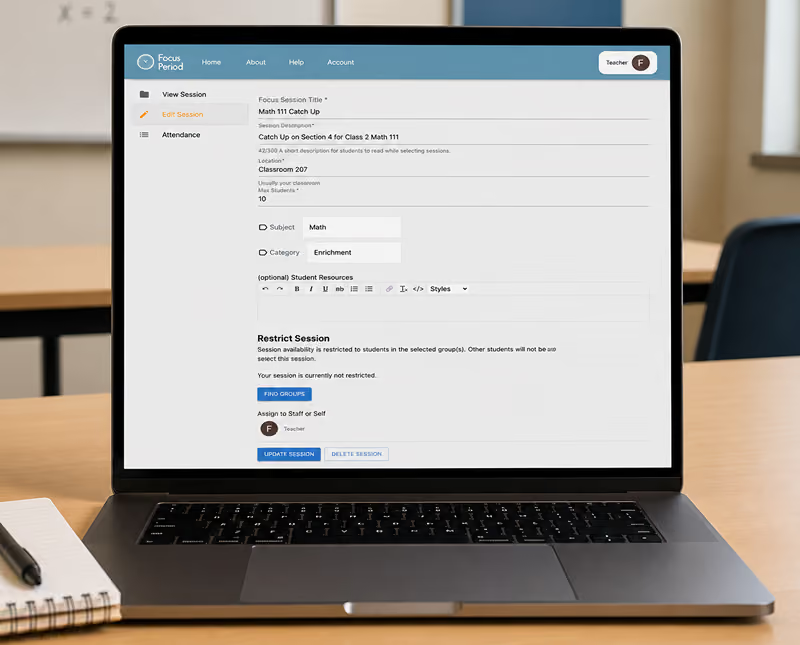
Teachers lock in the students who need to be somewhere specific. Everyone else picks their own session: academic help, enrichment, or quiet time to work. Any student who doesn't choose gets placed into a fallback session automatically, so nobody's left without a spot. The system keeps track of where every student is supposed to be. No manual lists required.
Three Roles, One System
Everyone sees the part of the day they're responsible for.
Students see their own sessions and choose from what's open to them on a given day. Teachers flag who needs to be in their session and take attendance in a few clicks. No separate list to keep. Administrators see the whole school at once: who's placed, who isn't, and how Focus Period is actually being used, without having to ask around to find out.
Hear It from Educators

Go for it! It is a great selling point for prospective parents. It allows for more student support and intervention as needed. Helps with not asking teachers to come in early or stay late.

Focus Period makes flexible scheduling far more organized and manageable. It reduces stress for administrators and staff while giving students a clearer, easier way to take responsibility for how they use their time.

Meeting each student’s needs is built right into our schedule with Focus Period. During our Focus Period, teachers connect with students for strategic intervention or extension, right where it’s needed most.
Already Running Something Like This?
Already have WIN time, an advisory period, or a built-in tutoring block? Focus Period doesn't replace it—it gives your school a better way to manage it.

Questions? We’ve got answers.
About the product
A Focus Period is protected time built into the school day where students are placed based on need, not left to sit unstructured. Teachers lock in students who need targeted help; everyone else chooses their own session.
Teachers flag students who need intervention and those students are locked into that session automatically. Every other student selects from the sessions available that day. If none are selected, the student is automatically placed in a relevant session.
Yes. Schools use it for athletics, arts rehearsal, student leadership, career exploration, counseling groups, club meetings, and more.
Middle and secondary. Students need to be able to navigate choosing and managing their own sessions.
Setup and onboarding
A short intake covering the school's email platform, size, device setup, and current intervention processes, followed by a setup call.
It works alongside it. Focus Period manages flex-period placement, attendance, and reporting specifically; it isn't meant to replace a school's core SIS.
Right now, yes. Focus Period runs on Google Workspace for school email and login. If your school uses Microsoft 365 or something else, reach out. We're tracking demand and can let you know if that changes.
Yes. A typical rollout includes working sessions with a small group of administrators or staff, plus the option to explore a demo school environment before going live.
For teachers and staff
Teachers lock in the students who need to be in their session and take attendance inside Focus Period, which is designed to be fast. Beyond that, the system handles placement and reporting.
Functionally, yes—once in the SIS and once in Focus Period, since flex time runs separately from the regular class schedule. Most schools find it becomes routine quickly.
Yes. Teachers who plan together can mix and match rosters during the Focus Period, one teacher taking a group strong in one area while another takes the group that needs more support.
It varies by school. Some run it daily; others a few times a week. This is a configuration decision each school makes, not something the platform locks in.